By CISA
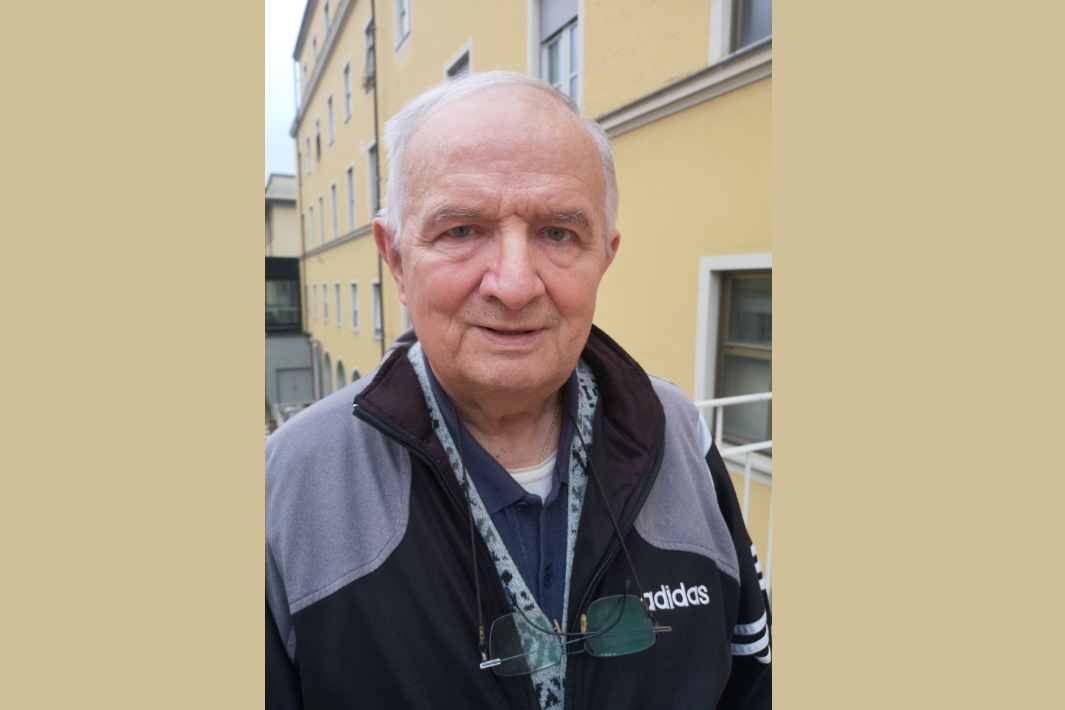
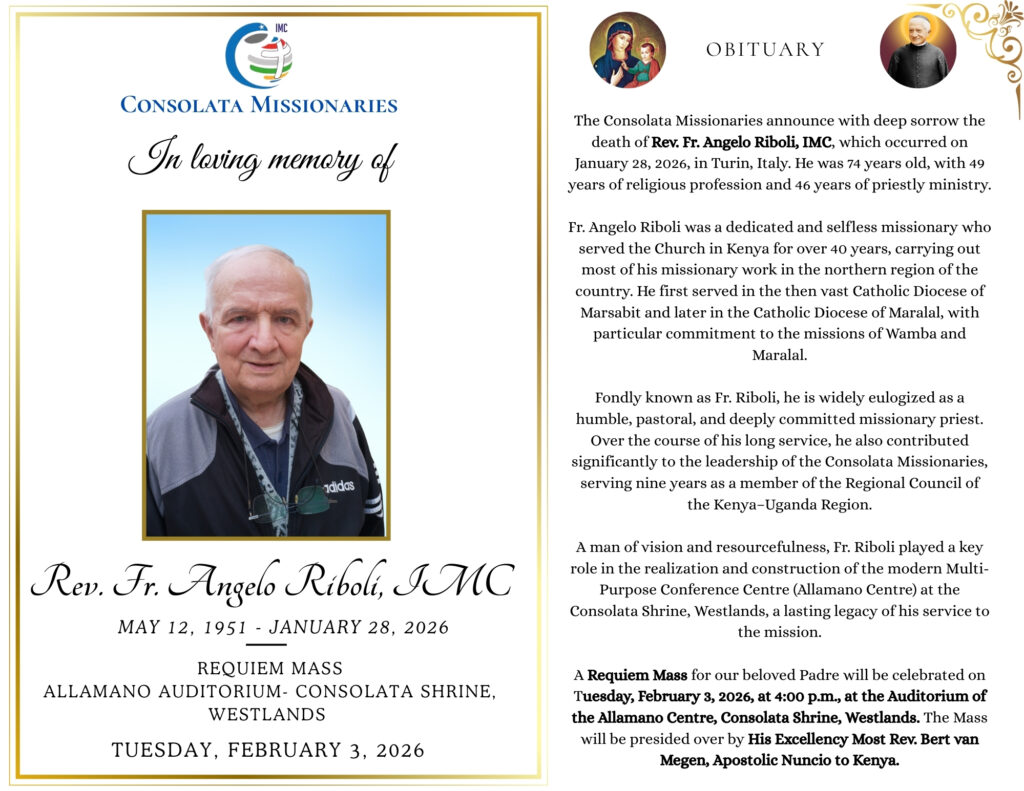
For more than four decades, Rev. Fr. Angelo Riboli, IMC, embodied the quiet resilience and pastoral dedication that defined the missionary vocation in Kenya’s northern frontier. Born in Crema, Italy, and ordained in 1979, Fr. Riboli arrived in Kenya shortly thereafter, committing the greater part of his priestly life to the vast and often demanding terrains of Wamba and Maralal, within what are today the Catholic Dioceses of Marsabit and Maralal.
Known for his humility, simplicity of life, and unwavering closeness to the people, he served not only as a parish priest but also as Diocesan Administrator and Regional Councilor for the Kenya, Uganda Region of the Consolata Missionaries. His leadership extended beyond pastoral care to institutional development, including his role in the realization of the Allamano Centre at the Consolata Shrine, Westlands.
Fr. Riboli, who passed away on January 28, 2026, in Turin at the age of 74, had 49 years of religious profession and 46 years of priesthood, years marked by fidelity to the missionary charism of the Consolata Missionaries. In the reflection that follows, he offers a personal meditation on the meaning of missionary life: its sacrifices, its hidden joys, and its enduring hope. His words stand as both testimony and legacy, an invitation to rediscover the heart of mission as lived on the peripheries.
1. Invitation to Remember
I entered the Consolata Missionaries community in 1975. I made my novitiate at the Certosa di Pesio in 1975-76. I made my first profession in Sassuolo (Reggio Emilia). I was a member of the small formation community in Sassuolo (seven clerics: two professed, two newly professed, three postulants, and one formator). This experience was desired by the clerics of the major seminary of the Mother House in Turin, for a more personalized formation. It was approved by the Major Superiors but immediately thwarted by the refusal to assign new students. It concluded after three years with the ordination of two members as priests. It was an experience imposed by the Italian Region but never accepted by the General Directorate.
I was ordained a deacon in Sassuolo in 1979, and a priest in Offanengo in 1979. In early October of the same year, I left for London to specialize in missiology at Mill Hill University in Totteridge.
His first missionary assignment was in Kenya (1981); the parish of SS. Consolata Westlands, as assistant parish priest. It was a wonderful but difficult experience. The parish community was very demanding and encouraged daily personal preparation, following a specific plan.
In January 1984, to make room for Father Barilone, who had been assigned to Westlands by the Major Superiors in Rome, I was sent to Mombasa for four months at the holiday home to replace Father Deleidi, who had to extend his stay in Italy for health reasons.
August 1984: I was assigned to Wamba, assistant parish priest of Father Gorzegno. At first, it was a very traumatic experience, with no help in understanding the new situation in which I was called to offer my service as an evangelizer. I couldn’t carry out any of my programs because I was constantly hindered by the parish priest. So much so that after only three months in Wamba, I received a proposal from Rome to return to Italy as assistant parish priest in Turin, at the Regina delle Missioni parish. After discussing with the then vice superior general and presenting the possibilities for a probable improvement, I remained in Wamba.
In 1986, I was appointed parish priest of Wamba. My experience as pastor lasted only nine months because, in 1997, our regional superiors accepted the request of Bishop Ravasi, Bishop of Marsabit, and I was appointed coordinator of the diocesan pastoral office, but only for the Samburu District. A new office was opened in Wamba. In 1988, I was joined by a Consolata Missionary, Sister Cesariana Corioni. We remained in Wamba until the end of 1990. In 1991, we moved to Maralal with our new assignment, where we opened the Joseph Allamano Pastoral Center in the old major seminary.
My service in this office lasted until September 1994, when I was asked to move to Nairobi as Regional Administrator. I served the Kenya Region until October 2000. During these years of service, I had the great opportunity to help Father Signorelli start the “Familia ya Ufariji” home for street children. Once the first children were welcomed, it also became the focus of my weekly pastoral ministry.
In October 2000, I returned to Wamba as parish priest. A very intense but also rewarding five-year experience. I established the pastoral council, various Catechesis groups, and various associations for children, youth, and adults. The Marriage Encounter movement began in the diocese; School and the beginning of lay ministries. The construction of three churches in three chapels, plus three respective houses for catechists. Sports activities, such as the Consolata Cup, begun in 1985, eventually attracting over 900 athletes to participate in the various sports activities offered by the competition.
In January 2006, I painfully “succumbed” to the insistent requests of Bishop Virgilio Pante, Bishop of Maralal, and agreed to become Administrator of the Diocese. This service continues to this day, but until when? I carry out my pastoral service in the Maralal district prison. I am slowly integrating myself into this new field of apostolate.
My missionary journey revolves around the axis: Nairobi-Wamba-Maralal-Nairobi-Wamba-Maralal. I am happy with these 26 years of apostolate in Kenya. I have always savored the presence of God and my Superiors in my work. I regret not having had the opportunity to deepen my knowledge of the Swahili language and not having participated in any of the scheduled refresher courses; this was due to the emergencies that arose in the Region, and the request to take charge of these emergencies.
I also had the opportunity to serve my confreres for nine years as a regional councilor.
I have been fortunate to have enjoyed good health; the only serious illness was an intestinal infarction, which fortunately resolved itself favorably. I also experienced being kidnapped by rebels during the 1982 coup d’état, which, with the help of God and the Consolata, was resolved in a few hours.
2. Invitation to read reality
The biggest challenge the institute in Kenya faces is the age and fatigue of its staff.
The institute lacks imagination, and therefore its staff also lacks imagination. We fear the risk; the reality we’ve experienced prevails: always the same people…
Too much concern for formation and too little for direct pastoral care. The institute is like a large museum where the human resources are divided into three rooms by job description:
In the first room, space is contested between the formators and the professors;
Second: Those with personal projects, the dreamers;
Third: The pastors; the latter are left to their own private initiative. A curriculum vitae is sufficient to become a priest;
In the storeroom are those who hold offices in the various dioceses.
In our official documents, we are bombarded with news about: meetings for formators, meetings for followers, meetings for justice and peace held annually at the continental or institute level. What about the pastors, those directly involved in pastoral care?
Those assigned to dioceses for specific tasks and offices: what place do they have in the region and the institute? It gives me the impression that they are nobody’s children.
3. Invitation to listen
Today, I have the impression that the people, our brothers, the local clergy, the bishops, social and political leaders, accept us not for what we came to bear witness to, for what our Fathers have done and what we continue to do, but for the money we bring in; we are seen as real estate agents with vast financial resources.
This does not do justice to our work and service to the missionary church.
4. Invitation to plan
But is it true that God dreams? When we are women, who takes care of us? Does the Institute allow its missionaries to dream? Personal projects?
Globalization has destroyed the economies of third-world countries and is destroying the community life of religious institutes. Importance is no longer given to community but to individuality, one’s own cell phone (the latest model), one’s own computer (the most expensive), one’s own email address, one’s own work and life plan or project, one’s own car, etc.
Can we still speak of a vow of poverty and obedience in our communities? Perhaps this lifestyle helps our people judge us as wealthy, and they don’t believe it if we can’t help them financially.
My dream is to take back the catechetical center of the diocese of Maralal under the responsibility of the Consolata Missionaries.
Training leaders is a huge challenge for us missionaries, and we cannot delegate it to others. It’s not true that we’re few, because when we want staff, we find them. It’s not a step backwards, because in the history of the Kenya region, we’ve retraced our steps many times: Regional Conference: “No more administrators in the dioceses.” In 2007, three brothers worked in the administrative offices of Maralal, Marsabit, and Isiolo.
Another dream: that when someone comes to my office, they consider me for who I am and don’t immediately start telling me, “I have a financial problem.” That I can have the opportunity to walk around the city without always having someone following me around and asking, “kitu kidogo.” That we can build a sincere friendship without exploitation. Without thinking or seeing the benefits that could arise.
We have become slaves to our people. We have lost the freedom of evangelization.
