By Staff Writer
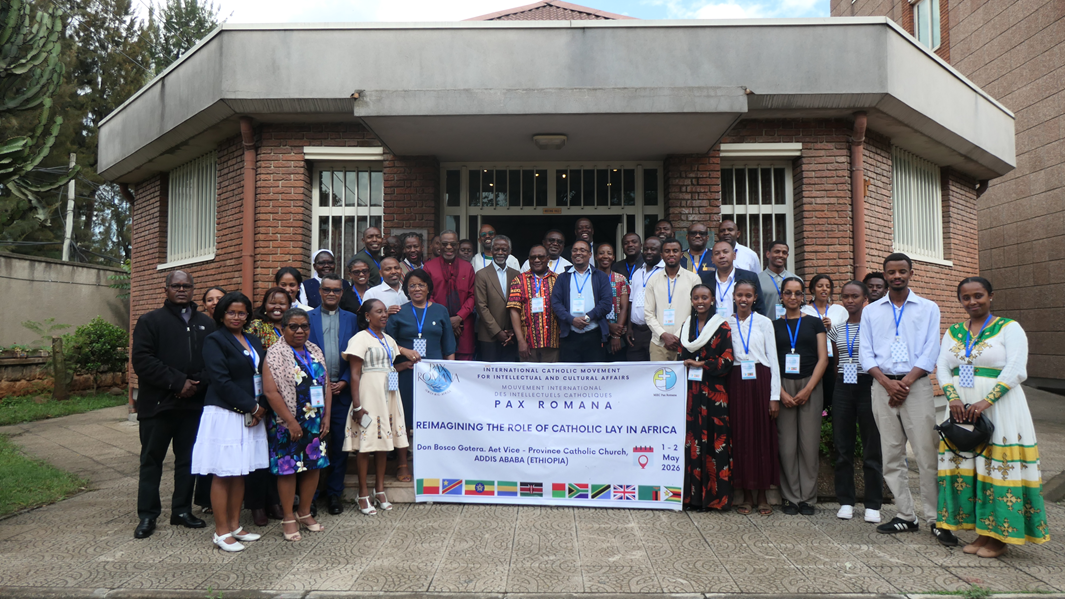
ADDIS ABABA, MAY 6, 2026 (CISA)– About 30 Catholic academics and professionals drawn from across Africa gathered in Addis Ababa from April 30 to May 2, 2026, for a continental reflection on the evolving mission of the Catholic laity under the theme “Reimagining the Role of Catholic Laity in Africa.” The meeting convened by the International Catholic Movement for Intellectuals and Cultural Affairs (Pax Romana-ICMICA), brought together intellectuals, scholars, and professionals
to examine the place of lay Catholics in shaping Africa’s social, cultural, and ecclesial future. Special Representative of the UN Secretary-General to the African Union and Head of UNOAU
At the opening Mass, His Eminence Berhaneyesus Demerew Souraphiel, Archbishop of Addis Ababa, challenged Catholic professionals to become “the salt of Africa,” urging them to place their knowledge, faith, and expertise at the service of the continent’s transformation.
Addressing the gathering in his capacity as a practicing Catholic, Parfait Onanga- Anyanga, Special Representative of the United Nations Secretary-General to the African Union and head of UNOAU, underscored the importance of faith and hope in navigating the complex challenges facing the world today, particularly within the framework of multilateralism.
In their statement, the Catholic academics and professionals reflected on the pressing challenges facing Africa, with particular concern over youth unemployment. They noted that while nearly 11 million young people enter Africa’s labour market each year, only about 3 million formal jobs are created annually, leaving millions without meaningful economic opportunities. The participants pledged to work alongside other stakeholders to confront the growing crisis of youth joblessness across the continent.
They also committed themselves to using their professional expertise in service of those living on the margins and peripheries of society.
“We are a unique category of people, with special gifts of professional formation and a responsibility to work towards the Africa we want, leveraging our numerical strength and presence in all spheres of life,” said Jean-Claude Kulondwa, a Congolese medical doctor who travelled for nearly four days from Bukavu, a conflict-affected region in eastern DRC, to attend the meeting in Addis Ababa.
“We are committed to accompanying the Church and other stakeholders to the margins and peripheries by deploying our skills,” added Jules Zanou, a sentiment echoed by Kaputo Chenga-Bwalya.
The participants also strongly criticised the current international financial architecture, saying it continues to limit African countries’ access to the financing needed for socio-economic development, and called for urgent reforms.
“We need an international financial system that does not push Africa to the periphery, but one that enables the continent to access resources needed to support the poor and those at the margins of society,” said Fredrick Wamalwa.
The Catholic academics and professionals further acknowledged the steady decline in traditional donor funding to Africa, including support for Church institutions. They pledged to place their expertise at the service of the Church by promoting innovative financing mechanisms, including ethical investments in financial markets aligned with Catholic social teaching and ecclesial values.
“We want a self-sustaining African Church, and we are ready to deploy our skills towards that,” read part of the concluding statement presented during the closing session in the presence of Archbishop Brian Ngozi Udaigwe , the Apostolic Nuncio to Ethiopia, who had earlier encouraged participants not to shy away from active engagement in public and political life.
The participants also underscored the need for continuous formation of lay Catholics across Africa, committing themselves to work with relevant Church structures to expand formation programmes for the laity as a means of translating the Gospel into tangible spiritual and social transformation.
In the same spirit, Fr. Johane Maseko called for personal conversion among members, urging them to continually seek the guidance of the Holy Spirit in their professional and apostolic engagements.
The gathering was also attended by Fasika Lachore, based in Paris, as well as Catholic professionals and students from Benin, the Democratic Republic of Congo, Ethiopia, Kenya, Madagascar, South Africa, Zambia, and Zimbabwe, accompanied by their chaplains.Also present was Fr. Emerick Louison, Chaplain of the African Union and representative of SECAM to the continental body.
