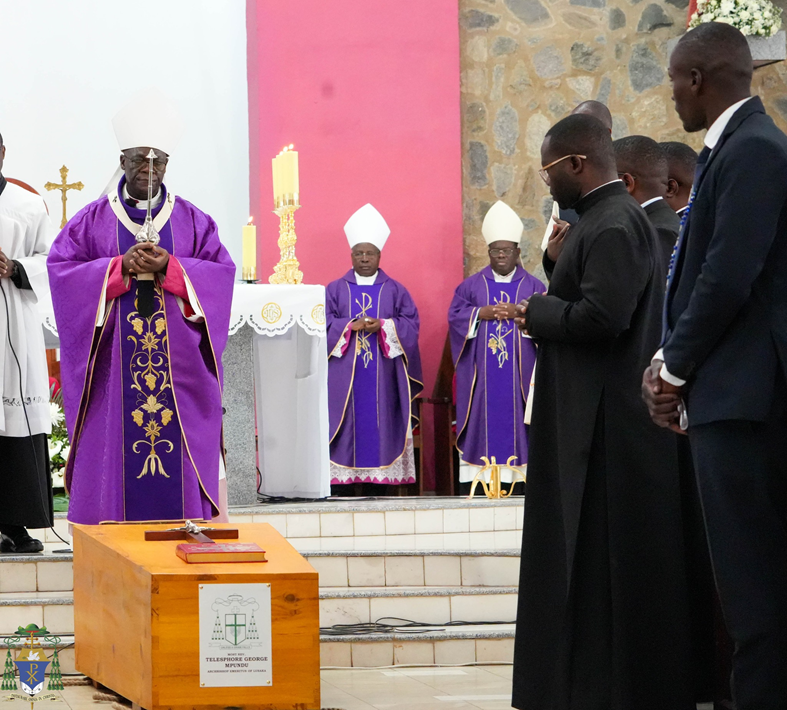
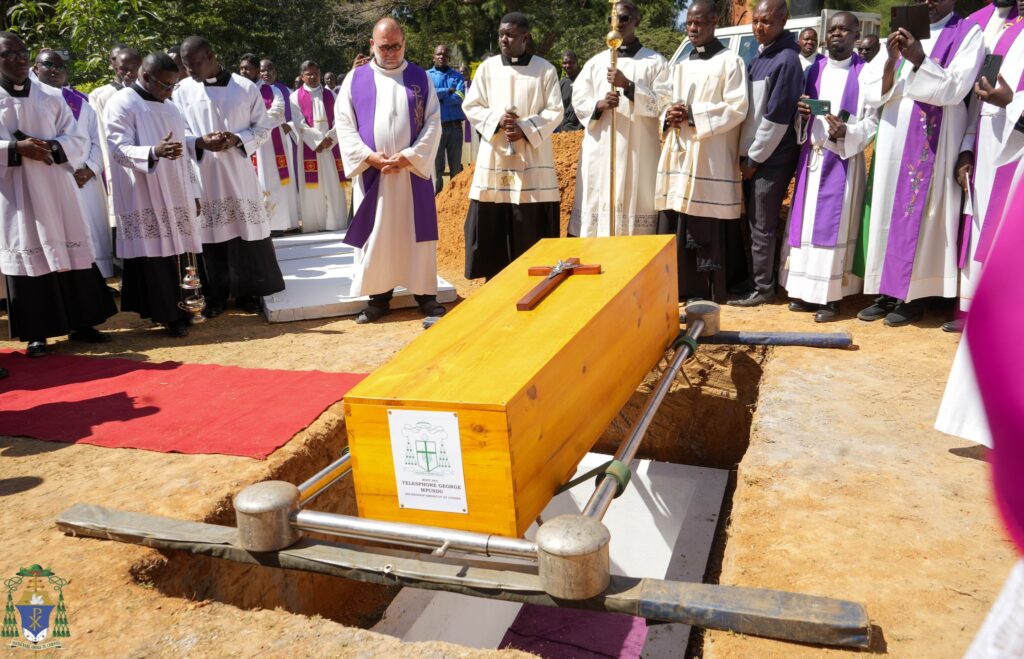
LUSAKA, MAY 25, 2026 (CISA) – The late Most. Rev. Telesphore George Mpundu, Archbishop Emeritus of Lusaka, was laid to rest at the burial site of the Cathedral of the Child Jesus in Lusaka on May 21, bringing to a close the turbulent yet influential life of one of Zambia’s most outspoken Catholic clerics whose final years were marked by both public admiration and ecclesiastical controversy.
Thousands of mourners, among them Catholic bishops, clergy, political leaders and faithful, gathered at the Cathedral of the Child Jesus, Pope Square, to pay their last respects to the former Archbishop of Lusaka, who died on May 15 at the age of 78, just a day before what would have been his 79th birthday.
The funeral Mass was presided over by Archbishop Alick Banda of Lusaka, who praised his predecessor as a courageous defender of justice and a prophetic voice who refused to remain silent in the face of oppression and bad governance.
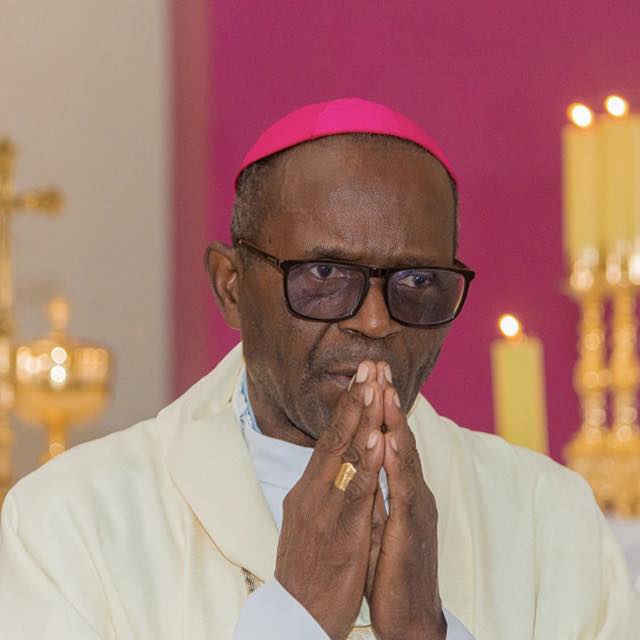
“We thank God for the life of Archbishop Mpundu, a shepherd dedicated to serving God and His people,” Archbishop Banda said in his homily, adding “His ministry was characterized by courage to defend the weak; humility in being unassuming; wisdom in reading the signs of the time; and indeed, his faithfulness to the Gospel.”
In an emotionally charged tribute, Archbishop Banda described the late prelate as a fearless churchman who consistently challenged corruption, abuse of authority and the marginalization of vulnerable people in society.
“He put people first and believed in calling a spade a spade, not a big spoon,” Archbishop Banda remarked, drawing applause from mourners gathered inside the packed cathedral.
The Archbishop said Mpundu had dedicated his life to defending democracy, social justice and human dignity regardless of tribe, religion, gender or political affiliation. He said the former archbishop strongly opposed dictatorship, institutional polarization and political indifference toward citizens living in poverty.
“He refused to be a part of an establishment that betrayed the tenets of democracy,” Archbishop Banda said, stating that “He championed a level playing political landscape for all and vehemently refused to remain silent in the face of injustice.”
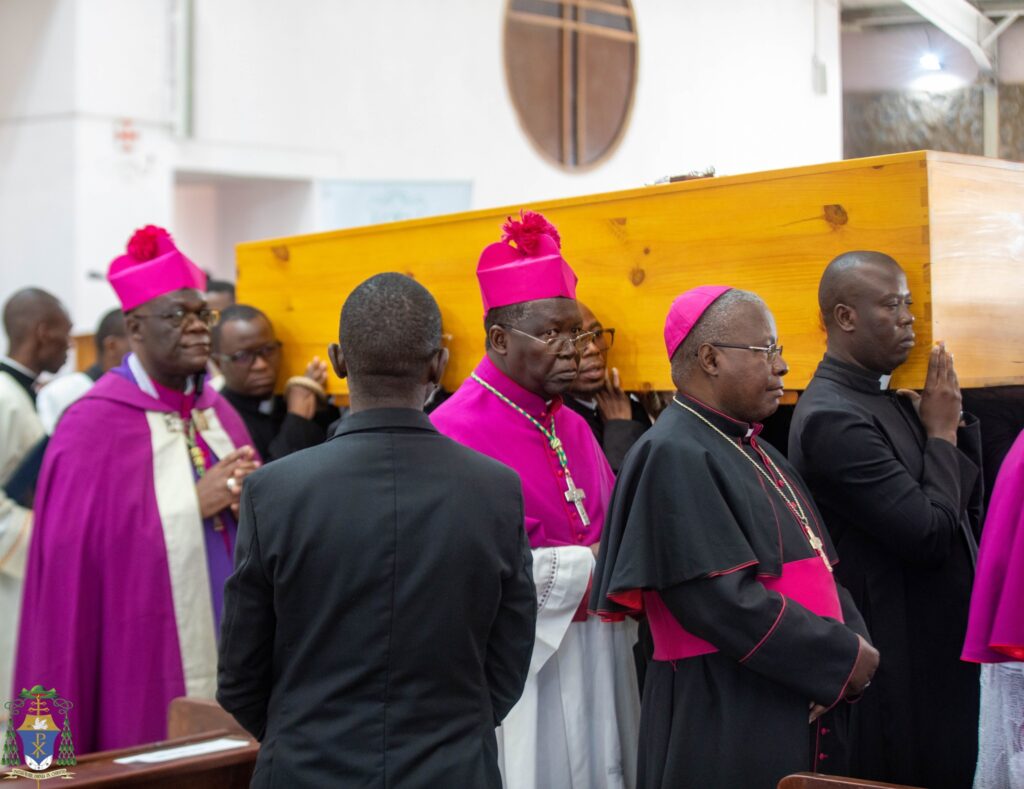
Throughout his ministry, Archbishop Mpundu earned a reputation as one of Zambia’s most vocal Catholic leaders, frequently speaking out on governance issues, human rights violations and economic inequality. He was particularly remembered for advocating for refugees, prisoners, the poor and other marginalized communities.
Yet even as tributes poured in celebrating his social witness, the shadow of a dramatic fallout with the Vatican lingered over his final days.
On March 19, 2024, Archbishop Mpundu incurred latae sententiae excommunication after participating in the covert episcopal consecration of Fr. Anthony Ward without papal approval.
The controversy became public months later when Bishop Ward disclosed that he had secretly been consecrated by Archbishop Mpundu in a ceremony conducted according to the Traditional Rite but without the mandate required from the Pope under Canon Law.
Ward revealed on November 16, 2024, that both he and Archbishop Mpundu had received formal notice from Cardinal Víctor Manuel Fernández , Prefect of the Dicastery for the Doctrine of the Faith, informing them that they had automatically incurred excommunication.
Under Catholic Church law, the unauthorized consecration of a bishop without papal approval is considered a grave canonical offense carrying automatic excommunication for both the consecrating bishop and the person ordained.
The controversy stunned many within Zambia’s Catholic community, given Archbishop Mpundu’s long-standing reputation as a respected church leader and former president of the Zambia Conference of Catholic Bishops (ZCCB).
Despite the canonical sanctions, many mourners at the funeral chose to remember him primarily for his decades-long pastoral ministry, his outspoken defense of democratic values and his commitment to social justice.
