By Paschal Norbert
NAIROBI, MAY 5, 2026 (CISA) – Hekima University College (HUC) has reaffirmed its standing as a premier institution of higher learning, a center of theological scholarship and ministerial formation with the launch of innovative and market-responsive academic programmes during the Closing Mass Assembly for the Academic Year 2025/2026 on April 29, 2026. The unveiling marks a significant milestone in the institution’s strategic growth, positioning Hekima as a dynamic center for intellectual formation, research, and societal transformation in Africa and beyond.
The launch, held within a reflective liturgical and academic setting, underscored HUC’s commitment to reading the “signs of the times” and responding with programmes that are both academically rigorous and globally relevant. The newly introduced courses, already approved and commended by the Commission for University Education (CUE), were lauded as timely interventions aligned with evolving global demands and contemporary societal challenges.

Delivering his address, the Principal of HUC, Rev. Dr. Marcel Uwineza, SJ, emphasized the transformative vision underpinning the new programmes, situating them within the broader mission of Jesuit education: “This is the story of education. It is the story of every student who comes uncertain and leaves transformed… Hekima has declared that education must never be detached from reality, and so these programmes are responding to the apostolic preferences of the Society of Jesus. True scholarship must engage suffering, awaken hope, and prepare leaders who can heal societies rather than merely succeed within them.”
Dr. Uwineza elaborated that the programmes, including the Master of Arts in Theology, Master of Arts in Spirituality, Bachelor of Science in Business Innovation and Social Entrepreneurship, and Bachelor of Arts in Migration, Security and Diplomacy, are deliberately designed to address pressing global and regional concerns such as conflict, migration, ethical leadership, and socio-economic transformation.
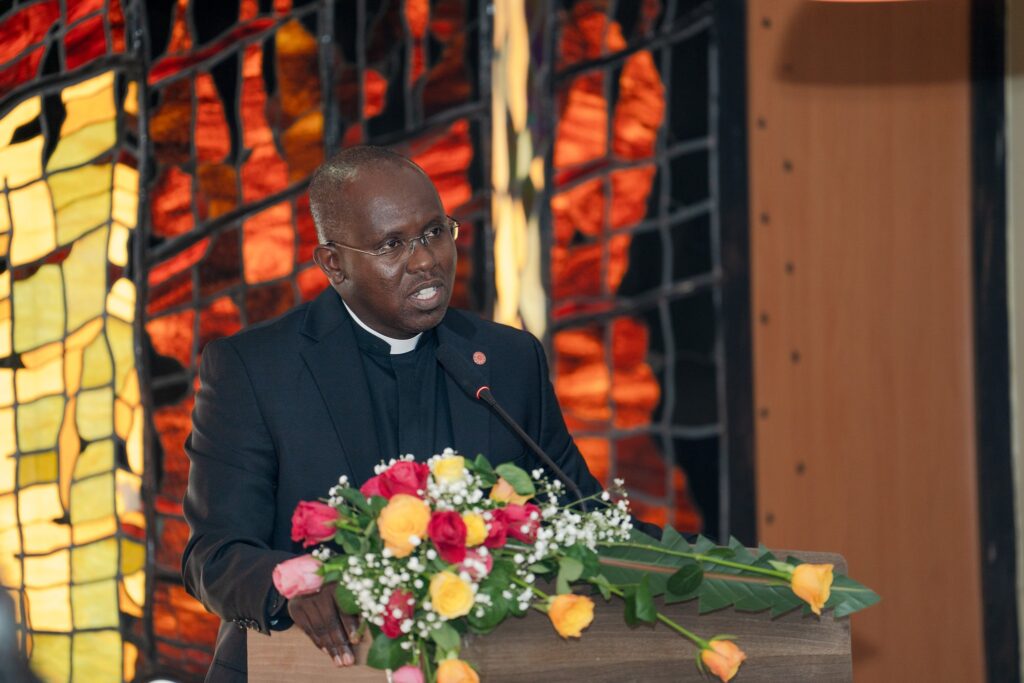
In a detailed interview at the end of the launch, the Principal highlighted the uniqueness and marketability of these courses, noting their interdisciplinary and practical orientation, “Each of these programmes responds to the current problems and challenges… Where do you have such a combination in this city of Nairobi? Not to speak of the rest of Africa… Business Innovation and Social Entrepreneurship… Migration, Security and Diplomacy… These are programmes that prepare students not just to look for jobs, but to create them, to lead, to reconcile, and to build peace.”
He further pointed out that graduates of these programmes are well-positioned for careers in international organizations such as the United Nations and African Union, as well as in diplomacy, security sectors, entrepreneurship, and pastoral leadership.
The relevance of the new academic offerings was equally affirmed in the homily delivered by Rt. Rev. Rodrigo Mejía, SJ, Emeritus Vicar Apostolic of Sodo, Ethiopia, and a founding member of HUC who drew from his six decades of missionary and academic experience in Africa.
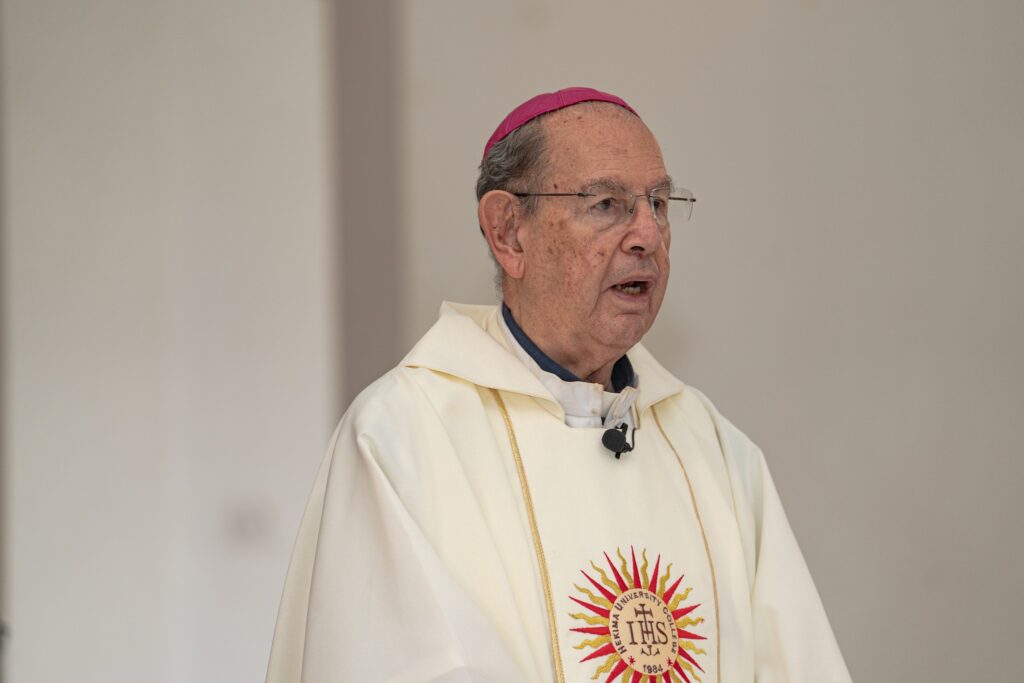
“Listening to the reports… especially the growth of Hekima University College, four new courses… I was very happy… From now on, they don’t have to go to Rome for that. They can get it here… This is a blessing… I have been a personal witness of the growth of the Church and the progress of theological reflection in Africa,” he said.
Bishop Mejía underscored the historical significance of such developments, recalling a time when theological education in Africa was limited or non-existent. He noted that the expansion of programmes at HUC signals not only institutional growth but also the maturation of theological and intellectual scholarship on the continent.
The newly launched programmes also align closely with HUC’s strategic plan, particularly its aspiration to attain a university charter and become a fully-fledged university. Dr. Uwineza reaffirmed this trajectory, pointing to ongoing investments in infrastructure, academic policy frameworks, and Open, Distance and E-Learning (ODEL) systems.
“We dreamed deep in innovation. Learning can no longer be imprisoned by walls. Education must go where people are… We are sending a clear message: you belong here even without coming physically… your place at the table of knowledge is secure,” he rallied.
Through ODEL, HUC aims to expand access to education across continents, enabling students from diverse geographical and socio-economic contexts to benefit from its programmes. The model, already structured with a hybrid delivery approach, is expected to transition into fully online offerings upon full accreditation.
Beyond the newly introduced courses, HUC continues to offer a robust portfolio of academic programmes. These include a Bachelor of Theology, Master of Peace Studies and International Relations, a Diploma in Religious Education, and a Certificate in Pastoral Leadership.
Complementing these are a range of targeted certificate programmes designed to deepen both ministerial competence and professional capacity, including a Certificate in Retreat Direction, Certificate in Theology for the Laity, Certificate in Theology for Religious, Certificate in Conflict Resolution, Peace Building and Reconciliation, and a Certificate in Project Management and Leadership. Additionally, the institution provides ecclesiastical degrees through the Faculty of Theology of the Jesuits in Africa and Madagascar (FTJAM), awarded in the name of the Holy See.
The Hekima Institute of Peace Studies and International Relations (HIPSIR), established in 2004, remains a flagship entity addressing Africa’s urgent need for peacebuilding, conflict resolution, and international cooperation. Complementing these are specialized centres such as the Jesuit Historical Institute in Africa (JHIA), the Centre for Research Training and Publications (CTRP), the Jesuit Centre for Safeguarding in Africa (JSCA) and the Centre for Interfaith Studies in Africa (CISA) plays a critical role in fostering dialogue, mutual understanding, and collaboration among diverse religious traditions.
Tracing its roots to 1984, Hekima began as a Jesuit School of Theology serving a small number of students from the Society of Jesus. Over the decades, it has evolved into a vibrant academic community hosting students from numerous religious congregations and lay backgrounds.
Today, HUC stands as an inclusive institution open to all, seminarians, lay students, professionals, Kenyans, and international scholars alike, regardless of religious affiliation. This openness, the Principal emphasized, is central to its identity and mission: “Hekima is open to everybody… not only for Jesuits… even those who don’t believe in God are welcome… we form the whole person, mind and heart.”
Looking ahead, the institution continues to expand its academic frontiers, with plans to introduce doctoral programmes and further strengthen its research and global engagement footprint. The Principal issued a clarion call to prospective students:
“As we begin a new academic year… I urge you to enroll… Each of these programmes responds to the current challenges… Be part of this tradition… We are servants, and we are here to accompany you.”
